Dental Implant
Quality Dental Implants


As a dentists we see many “emergencies”, conditions for which patient insists on being seen over a weekend or at night. You would think a toothache would be the most common emergency; however, I have found over the years that people may be willing to put up with some pain when it is inconvenient for them to come to the dentist, but a missing or broken front tooth is something nobody tolerates.


As you may know, when a root form Titanium dental implant is placed in the jaw bone, it takes about 1.5 to 6 months to fuse (osseo-integrate) to the jaw bone. During this period, traditionally, either the space above the implant is left empty or a removable partial denture (a flipper made for the patient to wear) is used. Needless to say that while first option is totally unacceptable for a front tooth, the second option is a big inconvenience.
Even today, many patients needlessly are made to wear the removable flipper because the surgeon who places the implant in the jaw bone either is not equipped or skilled to fabricate a reasonable and comfortable fixed tooth for the healing implant.
This is one of the many drawbacks of the so called “team approach” in implant dentistry. The dentists who have limited their practice to only the surgical aspect of implant placement, usually do not have the materials and training necessary to restore the empty space with a comfortable and fixed option. In these cases, the patient is forced to make a separate appointment at a later date with the cosmetic (general) dentist who is equipped and trained for fabricating teeth to replace the missing tooth.
I have worked hard over the years and have earned dual fellowships in both the Academy of General Dentistry ( FAGD ) and International College of Oral Implantology ( FICOI ) . For years now, I have been restoring the newly placed implants in front of the mouth at the same sitting with a provisional restoration so that my patients would never walk out of the office without a comfortable and fixed tooth. This Approach is called Immediate Loading, or more commonly, same day implants.
Now a days the reason most people end up having a single front tooth implant is that either their existing tooth is broken from the neck or it is not salvageable any more. In either event, they walk in with some form of remaining root in their jaw bone. In most cases I have been able to remove the remaining root and place the implant in its place at the same time. This is called Immediate Placement of dental implants. In most cases, when I replace a front tooth, I practice immediate Placement and Immediate Loading of my implants. When patients follow the instructions in terms of rest and taking antibiotics, my success rate is 100%.
In cases that for technical reasons, when the implant cannot be immediately loaded, I fabricate a bonded fixed bridge over the implant before the patient is dismissed, so that the patient can leave the office confidently with a fixed tooth.
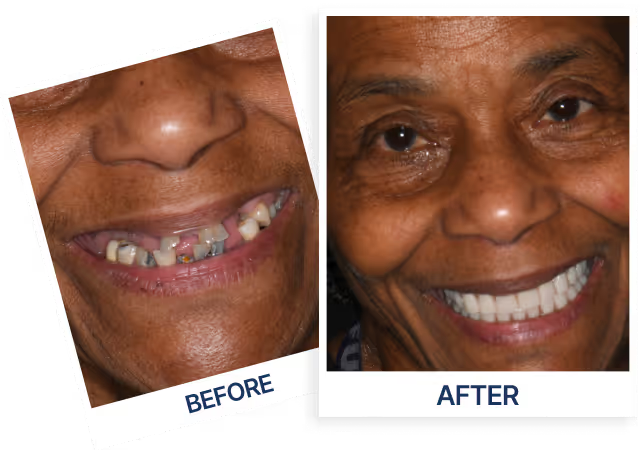
A consideration in front teeth implants is their high esthetic demand. As far as clinical skills, knowledge and experience is concerned, this is where rubber meets the road. Look at the photograph labeled natural looking single tooth implant. Also pay attention to Kay’s pictures. Kay an otherwise handsome young man, was presented by a previous dentist with an old, fake looking, bridge for tooth number 9. To correct this, I placed an implant at bone level for him (Kay2).
To avoid the usual grayish discoloration that we see at the neck of Titanium implants, I used a Zirconium abutment. Because the implant was at the bone level and the final 2 millimeter of the implant (the emergence profile) was in Zirconium, no grayish discoloration was shown through the gum margin. I prepared the Zirconium for optimal position of the Zenith (the highest part of arch of the gum). The result is an astonishingly natural looking and literally indiscernible emulation of the adjacent natural tooth (Kay4).
A great degree of skill and experience is involved in shaping the emergence profile of the front tooth implant so that to preserve the interdental papilla (the gum extending down from in between the teeth) where it exists (Jill’s case) or to create a pair where there is a flat ridge- case of Kevin.


